Managing payments is an important part of running a tailor shop. Customers need clear receipts, staff need accurate payment records, and shop owners need to know which orders are paid, partially paid, or still outstanding. When these tasks are handled with paper receipts and manual records, small mistakes can quickly become difficult to manage.
How Digital Receipts Can Make Tailor Shop Payments Easier is especially important for businesses handling many custom orders, alterations, repairs, and advance payments.
Digital receipts give tailor shops a simpler way to record transactions and provide customers with payment information. Instead of searching through receipt books or checking handwritten notes, staff can keep payment details connected to the customer’s order.
With a tailor shop management system such as GarmentDesk, payment information can become part of the same workflow used to manage customers and orders.
What Are Digital Receipts for Tailor Shops?
A digital receipt is an electronic record of a payment a customer makes. Instead of printing a paper receipt, the shop can provide the receipt digitally through an appropriate communication channel.
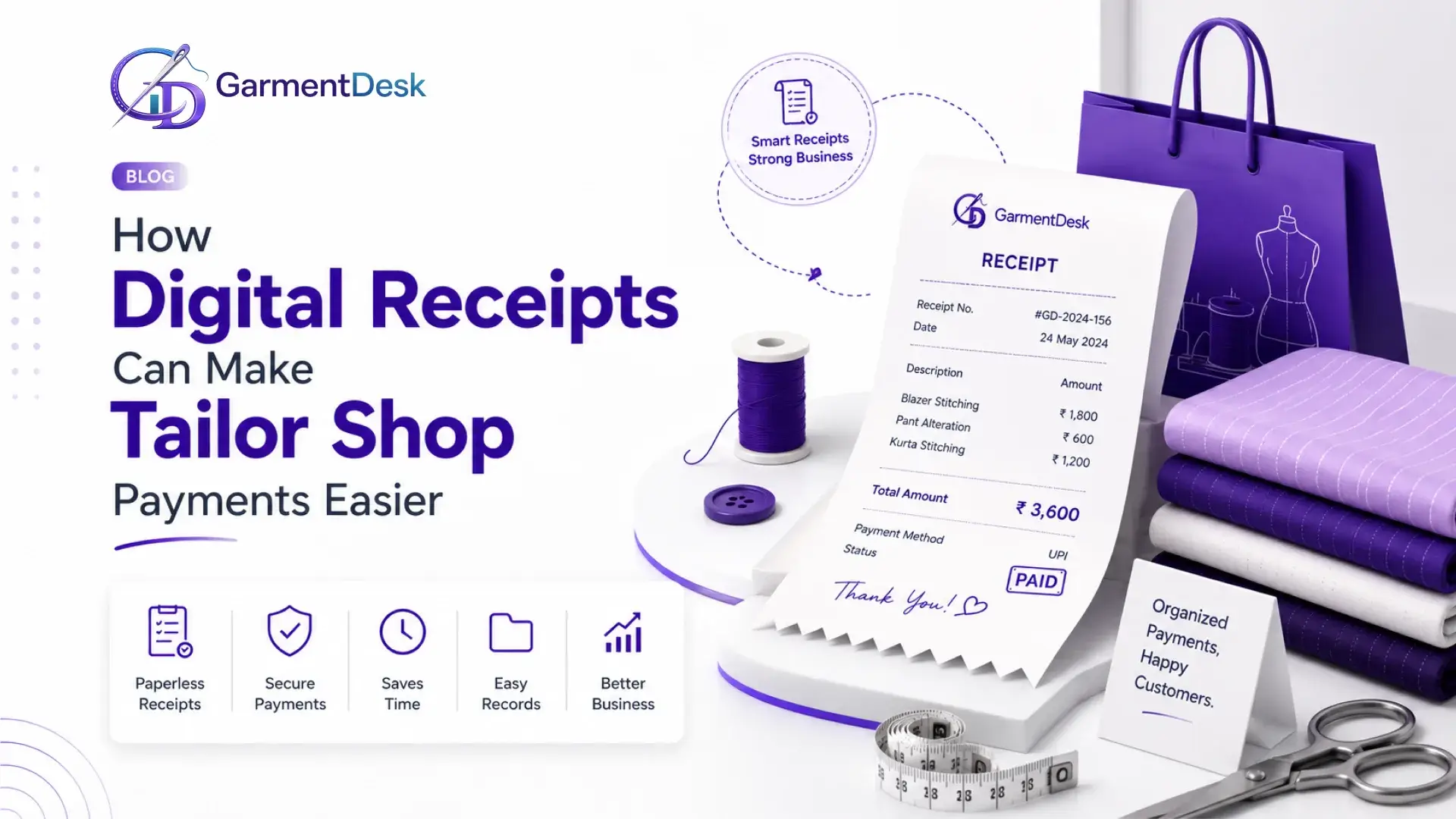
For a tailoring business, a digital receipt can contain information such as:
- Customer name
- Order number
- Items or services ordered
- Total order amount
- Amount already paid
- Remaining balance
- Payment date
- Payment method
- Receipt or transaction reference
This information gives both the tailor shop and the customer a clear record of the transaction.
Digital receipts are particularly useful when a customer pays a deposit when placing an order and completes the remaining payment when the garment is ready.
Why Payment Management Can Be Difficult in a Busy Tailor Shop
Tailor shops often manage several types of payments. A customer may pay an advance for a bespoke garment, make a partial payment for an alteration, or pay the full amount when collecting an order.
When payments are recorded manually, staff may need to update several places at once.
For example, a tailor shop might use:
- A paper receipt book
- A notebook for customer balances
- A spreadsheet for order information
- A separate payment record
- Messages to remind customers about balances
Managing these records separately increases the chance of entering the wrong amount or forgetting to update an order.
A digital payment record can help bring these details together.
How Digital Receipts Can Make Tailor Shop Payments Easier
1. Reduce the Need for Paper Receipts
Paper receipts can be misplaced, damaged, or difficult to find later. Customers may also lose their copy.
Digital receipts provide an electronic record that can be shared with the customer without relying on a physical paper copy.
For the shop, this can also reduce the amount of time spent writing receipts manually.
2. Keep Payment Information Connected to the Order
A payment should not be treated as an isolated transaction. In a tailor shop, it is normally connected to a specific order.
For example:
Order total: $250
Deposit paid: $100
Balance: $150
A digital system can make this payment status easier for staff to understand while working with the customer’s order.
This is useful for bespoke tailoring, alterations, repairs, and other services where the customer may not pay the complete amount upfront.
3. Make Customer Balances Easier to Check
One common payment problem in tailor shops is knowing how much a customer still owes.
When information is written in different places, employees may need to calculate the balance manually.
Digital payment records can make it easier to check:
- Total order value
- Payments received
- Outstanding balance
- Payment history
This reduces unnecessary calculations and helps staff give customers accurate information.
4. Give Customers a Clear Payment Record
Customers want to know what they paid for and how much they still owe.
A well-organised digital receipt can provide a clear record of the transaction. It can include the order details, amount paid, and remaining balance where applicable.
This can be particularly helpful when customers have several garments or orders with the same shop.
5. Reduce Manual Data Entry
Writing the same customer and order information repeatedly takes time.
A tailor shop software system can reduce repeated data entry by keeping customer, order, and payment information together.
Instead of creating a separate handwritten receipt every time a payment is received, staff can record the transaction within the order workflow.
This can make payment processing more consistent during busy periods.
6. Make Payment Tracking More Reliable
Payment tracking becomes more difficult as the number of orders increases.
Imagine a shop has 100 active orders. Some customers have paid in full, some have paid deposits, and others have outstanding balances.
Finding this information manually can take considerable time.
Digital payment records can make it easier for shop owners and staff to review transaction information and identify unpaid or partially paid orders.
Digital Receipts vs Paper Receipts for Tailor Shops
Both paper and digital receipts can provide proof of payment, but they work differently.
| Paper Receipts | Digital Receipts |
|---|---|
| Require physical paper | Stored electronically |
| Can be misplaced | Easier to keep with digital records |
| Often require handwriting | Can use existing order information |
| Searching old receipts can take time | Payment records can be easier to review |
| Need physical storage | Reduce dependence on receipt books |
| Updating information may require manual work | Can be connected to order records |
The biggest advantage is not simply replacing paper. The real benefit comes from connecting payment information with the customer’s order and business records.
How Digital Payment Records Help Tailor Shop Staff
A busy tailor shop needs staff to spend time serving customers and managing garments rather than searching through paperwork.
Digital payment records can help staff quickly answer questions such as:
Has this customer paid the deposit?
How much is still outstanding?
When was the last payment received?
Which order does this payment belong to?
Having these details available in one place can make daily payment management easier.
Digital Receipts Can Support Better Customer Service
Payment records are also part of the customer experience.
Suppose a customer returns to the shop and asks about a previous alteration. If staff can quickly find the customer’s order and payment information, they can provide an answer without searching through several notebooks.
Clear records can also help prevent misunderstandings about:
- Deposits
- Remaining balances
- Order totals
- Payments already made
- Completed transactions
Good record-keeping supports a more organised customer experience.
Digital Receipts and Tailor Shop Invoices
Receipts and invoices have different purposes.
An invoice generally shows what the customer is being charged, while a receipt confirms that a payment has been received.
For tailoring businesses, both can be useful.
For example, when a customer places an order for a bespoke suit, the shop may create an invoice showing the total cost. When the customer pays a deposit, the shop can record that payment and provide a receipt.
The remaining balance can then be tracked until the order is completed.
Using a connected system for invoices and payment records can reduce the need to maintain separate manual records.
Use Digital Receipts Alongside Tailor Shop Management Software
Digital receipts are most useful when they are part of a wider order management process.
A tailor shop may need to manage much more than payments, including:
- Customer measurements
- Order details
- Alteration requirements
- Garment information
- Delivery dates
- Order status
- Customer communication
- Invoices
- Payments
- Outstanding balances
Using separate tools for every task can make the workflow harder to manage.
GarmentDesk is designed to help tailoring businesses manage their day-to-day operations from a more organised system.
Instead of treating payments as a separate task, shops can connect payment information with their customer and order records.
When Should a Tailor Shop Consider Digital Receipts?
Digital receipts can be especially useful if your shop:
- Handles a large number of orders
- Takes deposits or partial payments
- Has multiple employees
- Manages alteration and repair orders
- Frequently deals with customer balance questions
- Uses paper receipt books
- Has difficulty tracking outstanding payments
- Wants more organised customer records
Even a smaller tailoring business can benefit when payment records become difficult to manage manually.
How to Introduce Digital Receipts Without Complicating Your Workflow
Moving from paper to digital records does not need to happen all at once.
Start by identifying how your shop currently handles payments.
Step 1: Review Your Current Payment Process
Look at where payment information is currently recorded. Identify duplicate records, manual calculations, and areas where mistakes commonly occur.
Step 2: Connect Payments With Orders
Make sure each payment can be associated with the correct customer and order.
This is particularly important when customers have multiple active orders.
Step 3: Keep Receipt Information Consistent
Use a consistent format for receipts so customers and employees can easily understand the information.
Step 4: Train Staff
Employees should know how to record payments correctly and check outstanding balances before completing transactions.
Step 5: Review Payment Records Regularly
Shop owners should periodically review payment information to identify unpaid balances, incomplete records, or unusual transactions.
The Bigger Benefit of Digital Payment Management
The value of digital receipts goes beyond sending customers an electronic receipt.
The larger benefit is creating a more organised payment process.
When customer information, orders, invoices, and payments are connected, staff can spend less time searching for information and more time managing the actual tailoring work.
For growing businesses, this becomes increasingly important because manual systems become harder to maintain as the number of customers and orders increases.
Make Tailor Shop Payments Easier With GarmentDesk
A tailoring business needs accurate payment records just as much as it needs organised orders and customer information.
Digital receipts can help reduce paper-based work, make payment details easier to find, improve balance tracking, and give customers a clearer record of their transactions.
The key is to use digital payment records as part of a complete workflow rather than as a standalone replacement for paper receipts.
If you want to organise your customer, order, invoice, and payment processes in one place, explore GarmentDesk and see how it can support your tailoring business.
You can also book a demo to learn more about how GarmentDesk can fit into your shop’s daily workflow.
Frequently Asked Questions
What is a digital receipt for a tailor shop?
A digital receipt is an electronic record confirming that a customer has made a payment. It can include the order number, amount paid, payment date, and remaining balance where applicable.
Can digital receipts help track customer balances?
Yes. When payment information is connected to customer orders, staff can more easily see how much has been paid and what amount remains outstanding.
Are digital receipts better than paper receipts?
Digital receipts can be easier to store, search, and connect with customer and order records. However, the best approach depends on the shop’s workflow and customer requirements.
Can digital receipts be used for alteration orders?
Yes. Digital payment records can be useful for alteration, repair, bespoke, and other tailoring orders where customers may make deposits or partial payments.
Why should a tailor shop use payment management software?
Payment management software can help reduce manual record-keeping and make it easier to connect customer information, orders, invoices, payments, and outstanding balances.
How can GarmentDesk help a tailor shop?
GarmentDesk helps tailoring businesses organise important day-to-day operations, including customer and order management, payment-related workflows, invoicing, and other shop processes.