Running a tailor shop today looks very different from how it did even a decade ago. Where customer measurements once lived in dog-eared notebooks and order details were scribbled on paper tickets, most tailoring businesses now store this information digitally. Online bookings, digital invoices, and customer profiles have made daily operations faster and more reliable. But they have also turned every tailor shop into a custodian of sensitive personal data.
In the European Union, that responsibility comes with clear legal expectations. The General Data Protection Regulation (GDPR) sets the rules for how businesses collect, store, and use personal information, and it applies to tailoring businesses just as much as it applies to banks or online retailers. Data security matters even for small alteration studios, because the size of your shop does not reduce your obligations to the people whose details you hold.
This is exactly where GDPR compliant tailor shop software EU businesses can rely on becomes so valuable. The right system does much of the heavy lifting for you, protecting customer data while keeping your operations organized. In this guide, we will break down what GDPR means for tailors, the risks of ignoring it, and the practical steps that help you get compliance right.
What GDPR Means for Tailor Shops in the EU
At its simplest, GDPR is a law that protects how the personal data of EU residents is handled. It gives individuals control over their information and requires businesses to handle that data lawfully, fairly, and transparently. If you collect details from customers in the EU, GDPR applies to you, regardless of how big or small your business is.
Tailor shops and alteration businesses fall squarely within these rules because they routinely collect personal information. A typical customer record may include:
- Names and contact details
- Phone numbers
- Home or billing addresses
- Body measurements
- Payment and invoice details
- Order history and preferences
Lawful data handling means having a valid reason to collect each piece of information, using it only for the purpose you stated, and keeping it secure. Strong customer data protection is not just a legal box to tick; it is the foundation of a trustworthy tailoring brand.
Why Tailor Shops Handle Sensitive Customer Data
- Tailor shops often collect more personal data than many other local businesses. A coffee shop might only need a name for an order, but a bespoke tailoring studio needs precise body measurements, fitting notes, and a full record of past garments to deliver a quality result.
- Body measurements in particular are highly personal. They reveal details about a person’s body that many customers would never share casually, and they expect those details to be handled with discretion.
- Add online bookings and digital invoices to the mix, and the volume of stored data grows quickly, increasing your responsibility to keep it safe.
- This is why storing customer details in loose spreadsheets or paper files is risky. A misplaced notebook, a shared laptop without a password, or an unprotected spreadsheet can expose sensitive information in seconds.
- Tailoring workflows are detailed and customer-focused by nature, and the systems that support them should protect that information just as carefully as your team protects a customer’s favorite fabric.
Risks of Ignoring GDPR Compliance
| Risk of Ignoring GDPR | What It Means for a Tailoring Business |
|---|---|
| Financial penalties and fines | Fines can be significant even for small businesses found to be non-compliant. |
| Damaged customer trust | Clients are far less likely to return when they feel their personal information was mishandled. |
| Data breach exposure | Unsecured records can be lost, stolen, or accessed by the wrong people. |
| Operational disruption | Recovering from a breach or investigation pulls focus away from serving customers. |
| Negative online reputation | A single publicized incident can affect reviews and word-of-mouth referrals. |
The encouraging news is that most of these risks come from manual, informal processes. Secure digital systems dramatically reduce the chance of human error by centralizing data, controlling who can access it, and keeping reliable records, which makes compliance far easier to maintain day to day.
Key GDPR Requirements Every Tailor Shop Should Follow
You do not need to be a legal expert to meet your core obligations. A handful of practical principles cover most of what a tailor shop needs to do.
Collect Only Necessary Data
Gather only the information you genuinely need to deliver your service. If a detail does not help you complete an order or serve the customer, there is no reason to store it.
Get Customer Consent
Be clear about how you will use someone’s data, especially for marketing or follow-up communication. Customers should knowingly agree to receive messages rather than being added to a list by default.
Store Data Securely
Protect records with strong passwords and encrypted, cloud-based storage. Secure tailoring software keeps measurements, invoices, and contact details safe from unauthorized access.
Allow Customers to Request Data Removal
GDPR gives people the “right to be forgotten.” In plain terms, a customer can ask you to delete their personal data, and you should be able to honor that request without difficulty.
Maintain Access Controls
Not every team member needs to see everything. Limiting employee access to sensitive information is a simple but powerful way to use reliable tailor shop data protection software and reduce the risk of internal mistakes.
How Cloud Based Tailor Shop Management Systems Improve Compliance
A modern cloud-based tailor shop management system is one of the most effective ways to stay compliant without adding administrative burden. Instead of juggling paper files and scattered spreadsheets, everything lives in one secure, organized place.
- Centralized and secure data storage keeps all customer records in a single protected location.
- Automatic backups ensure information is not lost to a damaged device or human error.
- Controlled employee access lets you decide exactly who can view or edit sensitive details.
- Better record organization makes it easy to find, update, or delete a customer’s data on request.
- Reduced paperwork removes the physical files that are so easily lost or seen by the wrong people.
- Easier customer data management means responding to requests and tracking consent becomes routine.
For a busy tailoring business, these are not just compliance benefits; they are operational wins. Less time spent searching for records and chasing details means more time spent on craftsmanship and customer service.
Features to Look for in GDPR Compliant Tailor Shop Software
Choosing the right tool is a business protection decision, not just a software purchase. When evaluating an online tailoring management system, look for these features:
- Secure customer database with encryption to protect names, measurements, and payment details.
- Role-based access so staff only see the information relevant to their job.
- Cloud backup and recovery to safeguard records against data loss.
- Invoice and order tracking that keeps financial and order data organized and accurate.
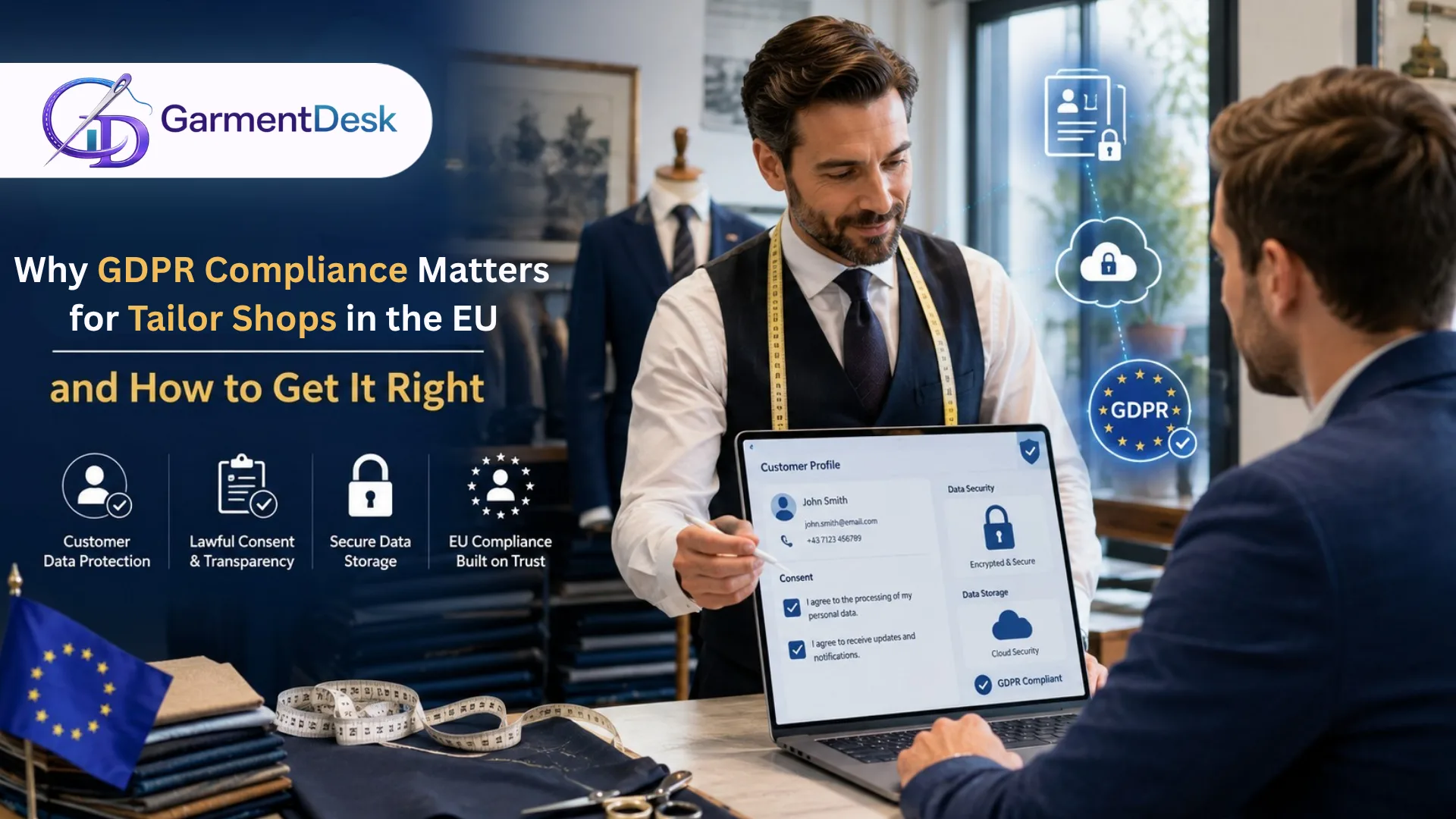
- Customer consent tracking so you can document who agreed to what, and when.
- Secure multi-store management for businesses operating across several locations.
- Audit trails and activity logs that record who accessed or changed data.
Together, these features form the backbone of dependable, GDPR compliant tailoring business tools that protect both your customers and your reputation.
How GarmentDesk Helps Tailor Shops Stay Organized and Secure
GarmentDesk is built specifically for tailors, alteration studios, and bespoke workshops, which means data protection is woven into everyday workflows rather than bolted on as an afterthought. Its security and GDPR features are designed with UK and EU shops in mind.
- Cloud-based workflow management keeps orders, alterations, and repairs in one secure system.
- A built-in customer CRM stores measurements, order history, and preferences with controlled access.
- Order tracking gives clear visibility of every job from intake to collection.
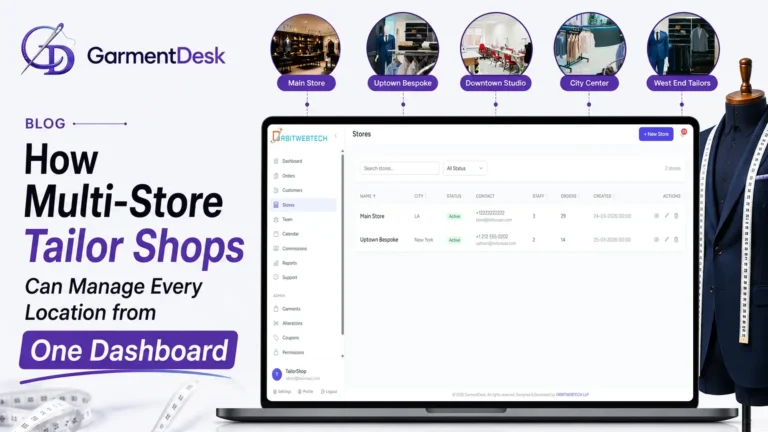
- Multi-store support lets each location have its own workspace while you oversee everything from one account.
- Advanced encryption and role-based access ensure only the right people see sensitive information.
- Complete audit trails and reliable infrastructure with strong uptime support accountability and continuity.
Because invoicing also supports EUR alongside other major currencies, EU tailoring businesses can manage finances and customer records within the same compliant environment. You can explore the full set of capabilities on the GarmentDesk features page. The goal is simple: help you run a tidy, professional, and secure operation so compliance becomes a natural part of how you work.
Best Practices for Protecting Customer Information
Good software works best alongside good habits. These practical steps help any tailoring team strengthen data protection:
- Use strong, unique passwords for every account and device.
- Train staff on basic data privacy so everyone understands their responsibilities.
- Regularly update your software to receive the latest security improvements.
- Avoid unsecured spreadsheets for storing customer measurements or contact details.
- Use secure cloud systems rather than local files that are easy to lose.
- Restrict device access so shop computers and tablets are not left open and unattended.
- Back up customer records regularly to prevent permanent data loss.
Adopting these GDPR compliant tailoring business tools and habits turns data protection from a worry into a quiet, dependable routine.
Common GDPR Mistakes Tailor Shops Should Avoid
Many compliance issues come from small, avoidable habits rather than deliberate negligence. Watch out for these common mistakes:
- Sharing customer information casually over chat apps or in conversation.
- Using unsecured personal devices to access sensitive records.
- Storing paper records carelessly where anyone can read them.
- Ignoring software updates that fix known security gaps.
- Having no employee access controls, so every staff member can see everything.
- Keeping old customer data forever instead of removing what you no longer need.
Avoiding these pitfalls protects your customers and shields your business from practical risks that are entirely preventable.
Final Thoughts
GDPR compliance is not red tape to be tolerated; it is a core part of running a respected tailoring business in the EU. The measurements, contact details, and payment information your customers share are sensitive, and protecting them is how you earn and keep their trust.
By understanding your obligations, following a few key requirements, and avoiding common mistakes, even a small shop can meet GDPR standards with confidence. Choosing the right GDPR compliant tailor shop software EU team can depend on makes that journey far simpler, combining secure data handling with smoother daily operations.
If you are reviewing how your shop stores and protects customer data, now is a good moment to evaluate a secure, cloud-based tailor shop management system. Doing so not only supports compliance but also helps your business run more smoothly, professionally, and securely for years to come.
Frequently Asked Questions
What is GDPR compliant tailor shop software?
It is software built to help tailoring businesses collect, store, and manage customer data in line with GDPR rules, using features like encryption, access controls, and secure cloud storage to protect personal information.
Why do tailor shops need GDPR compliance in the EU?
Because tailor shops collect personal data such as names, addresses, measurements, and payment details from EU residents, they are legally required to handle it securely and lawfully under GDPR, regardless of business size.
How can tailoring businesses protect customer measurements and personal data?
By storing records in an encrypted cloud system, limiting staff access, using strong passwords, training the team on privacy, and avoiding unsecured spreadsheets or loose paper files.
What features should a cloud-based tailor shop management system include?
Look for a secure customer database, role-based access, cloud backup and recovery, invoice and order tracking, consent tracking, multi-store management, and audit trails.
Is cloud-based tailoring software safer than paper records?
In most cases, yes. Cloud systems offer encryption, automatic backups, and access controls that paper files simply cannot, while also reducing the risk of records being lost, damaged, or seen by the wrong people.
Can small tailor shops face GDPR penalties?
Yes. GDPR applies to businesses of all sizes, so even small shops can face fines and reputational damage if they mishandle customer data.
How does tailoring software help manage customer consent?
Good software lets you record when and how a customer agreed to communication or marketing, making it easy to prove consent and respect customer preferences.
What are the benefits of secure tailor shop management systems?
They protect customer data, simplify compliance, reduce paperwork, improve organization, and free up time so you can focus on serving customers and growing your tailoring business.