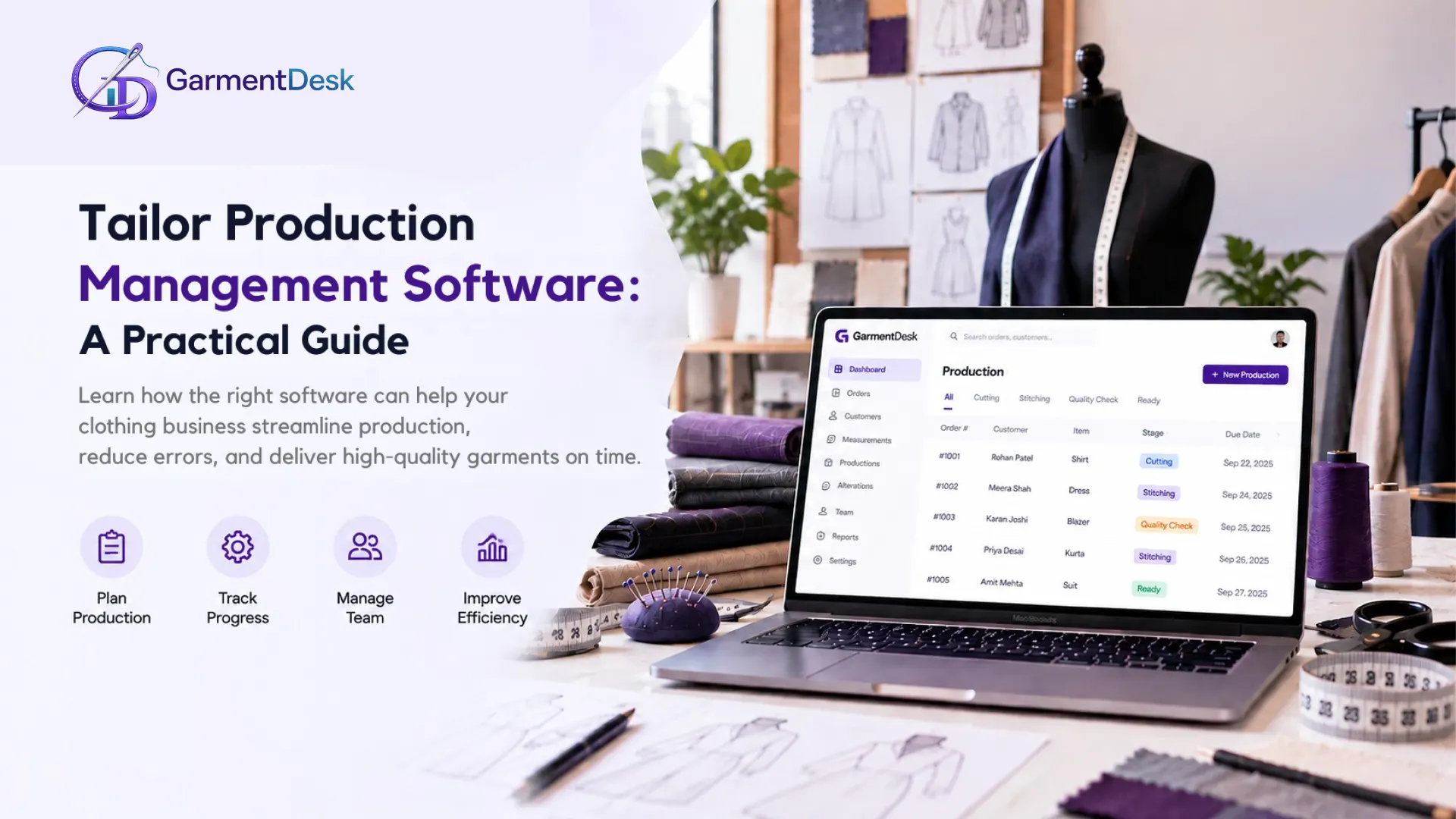
Managing a tailoring business involves much more than taking measurements and stitching garments. Every order may pass through several stages, including customer consultation, measurements, fabric selection, cutting, stitching, fittings, alterations, finishing, payment, and final collection.
When these details are managed through notebooks, spreadsheets, paper slips, or separate tools, it can become difficult to see what needs to be done next. Tailor production management software brings these activities into one system, helping tailor shops keep orders, production tasks, measurements, and customer information organized.
For businesses handling regular alteration work, made-to-measure clothing, or larger volumes of bespoke orders, the right system can provide a clearer way to manage daily production.
What Is Tailor Production Management Software?
Tailor production management software is a digital system designed to help tailoring businesses manage the complete journey of an order from booking to collection.
Instead of keeping production information in different places, a tailor shop can record important details in one system. Depending on the software, this can include:
- Customer details and contact information
- Garment measurements
- Order specifications
- Fabric and garment details
- Fitting dates
- Production stages
- Alteration requirements
- Payments and invoices
- Order status
- Delivery or collection dates
- Customer communication
For a tailor shop, the purpose is not simply to replace paper. It is to make it easier to understand which orders are pending, what work has been completed, and what needs attention next.
Why Tailor Shops Need Better Production Management
A busy tailoring business may have dozens or hundreds of active orders at different stages. A customer might be waiting for a first fitting while another garment is ready for finishing and a third order is still waiting for cutting.
When information is recorded manually, common problems can include:
- Misplaced measurement records
- Difficulty finding older customer orders
- Missed fitting or collection dates
- Unclear production status
- Repeated data entry
- Delays between production stages
- Mistakes caused by unclear instructions
- Difficulty tracking alterations
- Limited visibility into pending orders
A tailoring management software system gives the team a shared view of these details, making day-to-day production easier to follow.
How Tailor Production Management Software Works
A typical production workflow can start when a customer places an order.
1. Create the Customer Profile
The business can record the customer’s basic information and maintain their order history.
Having previous orders available can be useful when the customer returns for another garment. Staff do not always have to start from scratch when checking previous measurements or order details.
2. Record Measurements Digitally
Measurements are one of the most important parts of made-to-measure clothing.
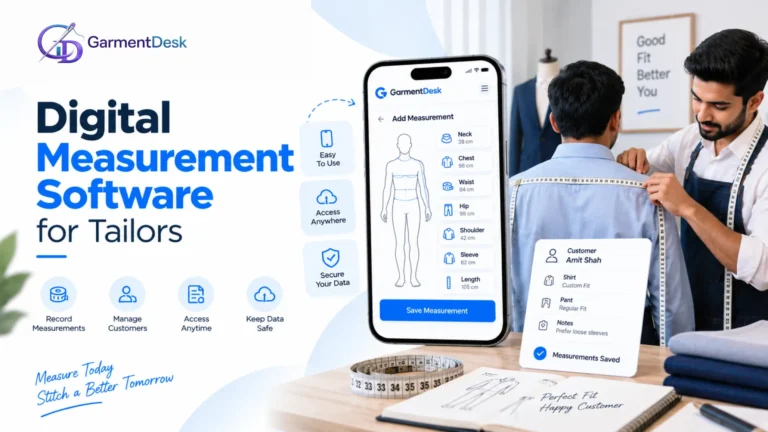
With digital measurement software, staff can record measurements electronically instead of relying on handwritten measurement sheets. Notes about garment preferences, fitting requirements, or special instructions can also be associated with the order.
This makes measurements easier to find when the garment moves into production.
3. Add Order and Garment Details
Each order can contain information such as:
- Garment type
- Style requirements
- Fabric details
- Quantity
- Customer preferences
- Special instructions
- Due date
- Fitting requirements
Keeping these details with the order reduces the need to search through separate notes.
4. Track Production Stages
A tailor production workflow may include several stages:
Order Received → Measurement → Cutting → Stitching → Fitting → Alteration → Finishing → Ready for Collection
The exact workflow can vary between businesses. Production management software helps teams track where an order currently stands and identify work that still needs to be completed.
5. Manage Fittings and Alterations
Fittings can create additional work because garments may need adjustments before they are completed.
A digital system can help record fitting notes and alteration requirements against the relevant order. This gives the production team a clearer reference when the garment returns for further work.
6. Complete the Order and Payment
Once production is complete, staff can update the order status and record payment information.
This creates a complete record of the order rather than leaving payment, production, and customer information in separate places.
Key Features to Look for in Tailor Production Software
Not every tailoring business has the same workflow, so software should be evaluated according to the work your shop actually handles.
Order Tracking
Tailor order tracking software should make it easy to check an order’s current status.
Instead of asking different employees for updates, staff can check whether an order is waiting for cutting, stitching, fitting, alteration, finishing, or collection.
Digital Measurements
A good system should make customer measurements easy to record and retrieve.
This is particularly useful for customers who place repeat orders because their previous measurement information can be available when creating a new order.
Production Workflow Management
Production management becomes more useful when each stage of an order can be clearly identified.
A tailor production management system can help the team understand which jobs are currently active and which orders require attention.
Customer Management
A tailoring business needs more than production records. Customer information, previous orders, measurements, preferences, and communication can all be useful when serving repeat customers.
This is where tailor shop CRM software can support the customer side of the business.
Invoicing and Payments
Connecting orders with invoices and payment records can reduce manual work.
Staff can see the financial status of an order without having to check a separate notebook or spreadsheet.
Appointment and Fitting Management
Fittings are an important part of bespoke and alteration work. Appointment scheduling can help the business keep fitting times organized alongside production deadlines.
Reports
Reports can help owners understand what is happening across the business, such as active orders, completed orders, payments, and production activity.
Tailor Production Management Software vs. Paper Records
Paper records are inexpensive and familiar, which is why many tailoring businesses continue to use them. The difficulty appears when the number of customers and orders increases.
| Paper-Based Management | Digital Production Management |
|---|---|
| Information stored in notebooks or files | Information stored in a central system |
| Measurements can be difficult to locate | Measurements can be searched and retrieved |
| Production updates may depend on staff communication | Order status can be updated digitally |
| Older order history takes time to find | Customer order history can be accessed more easily |
| Alteration notes may be separated from orders | Alteration details can stay with the order |
| Reports require manual preparation | Business data can be organized into reports |
The goal is not to eliminate every manual process. It is to reduce unnecessary searching, repeated entry, and uncertainty around order status.
Who Can Use Tailor Production Management Software?
A production management system can be useful for different types of tailoring businesses, including:
Bespoke Tailors
Bespoke businesses often manage detailed customer requirements, multiple fittings, individual measurements, and complex production stages.
Clothing Alteration Shops
Alteration businesses need to track garments, requested changes, customer instructions, promised dates, and collection status.
Tailor Shops
Traditional tailor shops can use digital systems to manage customer records, measurements, orders, payments, and production tasks in one place.
Uniform and Custom Clothing Businesses
Businesses producing uniforms or multiple garments for customers or organizations may benefit from having orders and production activities organized digitally.
What to Consider Before Choosing Tailor Shop Software
Before selecting tailor shop software, consider how your business currently works.
Ask questions such as:
- Can the software handle your type of tailoring orders?
- Can you record and retrieve customer measurements?
- Can you track production stages?
- Can you manage fittings and alterations?
- Can customers have multiple orders?
- Can you manage payments and invoices?
- Can staff access information when working from different devices?
- Can the system provide useful reports?
- Does it support the way your shop already works?
The best system should fit the workflow of your business instead of forcing your team to completely change how every order is handled.
How GarmentDesk Supports Tailor Production Management
GarmentDesk is built for tailoring businesses that want to manage their orders, customers, measurements, production, and payments from one system.
The platform brings key parts of the tailoring workflow together, including order tracking, customer management, measurements, invoicing, production management, and reporting.
For a tailor shop moving away from notebooks, spreadsheets, and disconnected tools, having these details in one place can make it easier to follow an order from the initial customer request through production and final collection.
GarmentDesk also supports businesses that need to manage their tailoring operations from different devices, giving teams a practical way to access their business information while working.
Moving From Manual Records to Digital Production Management
Switching to software does not need to mean changing everything at once.
A practical approach is to start with the areas where manual records cause the most difficulty. For one business, that may be measurements. For another, it may be order tracking or production status.
Once the core workflow is organized, additional processes such as customer management, invoicing, reporting, and follow-ups can be managed within the same system.
For tailoring businesses handling increasing numbers of orders, tailor production management software can provide a more organized way to manage the work behind every garment.